



New sod dies for one reason more than any other around here, and it isn’t heat, pests or bad grass. It’s that somebody watered it on the normal schedule.
Fresh sod has no root system. For its first weeks it’s a mat of grass lying on soil, drinking from a couple of inches of moisture that disappears fast in Florida sand. The standard two-day-a-week schedule that keeps an established lawn healthy will kill new sod in July, and most homeowners only find that out afterwards.
There is a rule that covers this. Most people have never heard of it.
The 60-day establishment window
Newly installed landscaping across the St. Johns River Water Management District — which covers all of Volusia and Seminole County — is allowed a temporary exception to the normal irrigation schedule:
- Days 1–30: water any day, at any time of day
- Days 31–60: water every other day
- Day 61 onward: you’re on your area’s standard schedule
The point of the window is to get roots down. Use the minimum water that keeps the sod moist — you’re not trying to flood it, you’re trying to stop it drying out before it anchors.
Keep your installation invoice with the date on it. That’s your proof of when the window started if anyone asks.
One thing that catches Seminole County residents out: the exception isn’t always automatic. In Seminole County you may need to email your installation receipt to the county’s water conservation address for it to apply. It’s a two-minute job that most homeowners never hear about. If we install your lawn, we handle that filing for you.
After day 60, your schedule depends on where you live – and what you’re connected to
This is where it gets messier than most people expect, because the rules are not uniform across the twelve cities we work in.
Your watering days are usually set by whether your house number is odd or even, and they change between Daylight Saving Time and Eastern Standard Time — most areas drop from two days a week down to one over the winter. Watering between 10am and 4pm is off the table year-round almost everywhere, and in most jurisdictions the rules apply to private wells too, not just utility water.
But three things vary enough to matter:
Some cities add their own caps. DeLand, for instance, runs its own city ordinance that limits not just the days but how much water goes down per zone and how long each zone may run. If your sprinkler coverage is patchy, you can’t compensate by running longer — you’re capped. The only real fix is head spacing and pressure.
Reclaimed water changes everything. If your property is on reclaimed rather than potable, you’re generally allowed to irrigate more often — and in some places, year-round rather than dropping to one day in winter. This matters enormously in Sanford, which runs both a potable and a reclaimed network, and in Lake Mary, where a lot of communities are on reclaimed and residents don’t always know it.
Coverage isn’t even within a single city. Winter Springs is the clearest example — some neighbourhoods have reclaimed service and parts of others have never had access to it. Two houses on the same street can be on genuinely different allowances. If you’ve been looking at a neighbour’s thicker lawn wondering what they know that you don’t, it may just be their pipe.
So: check with your city or utility which supply serves your address. It’s a single phone call and it changes how you should be watering.
Four things that kill new sod faster than the wrong schedule
A failed sprinkler zone nobody noticed. By far the most common cause we’re called out to. A head knocked off by a mower, a cracked line, a controller that lost its schedule after a power cut. On coastal or sandy ground, two weeks of a dead zone in summer is a lost lawn. It’s the number one killer on properties nobody lives in full time — a real problem in New Smyrna Beach, where a lot of homes sit empty for months.
Watering a shaded lawn like a sunny one. Grass under a canopy needs less water, not more, and running a full-sun schedule under an oak grows fungus rather than grass. If you’re in Longwood or Ormond Beach under mature trees, your shaded zones should be timed separately from your sunny ones.
Watering into ground that can’t hold it. Sandy, fast-draining soil sends water and nutrients past the root zone within hours. Around Orange City and the higher, sandier ground in DeBary, more water genuinely doesn’t help — the fix is building the soil so there’s something to hold it. Adding quality top soil before sod goes down does more than any schedule change.
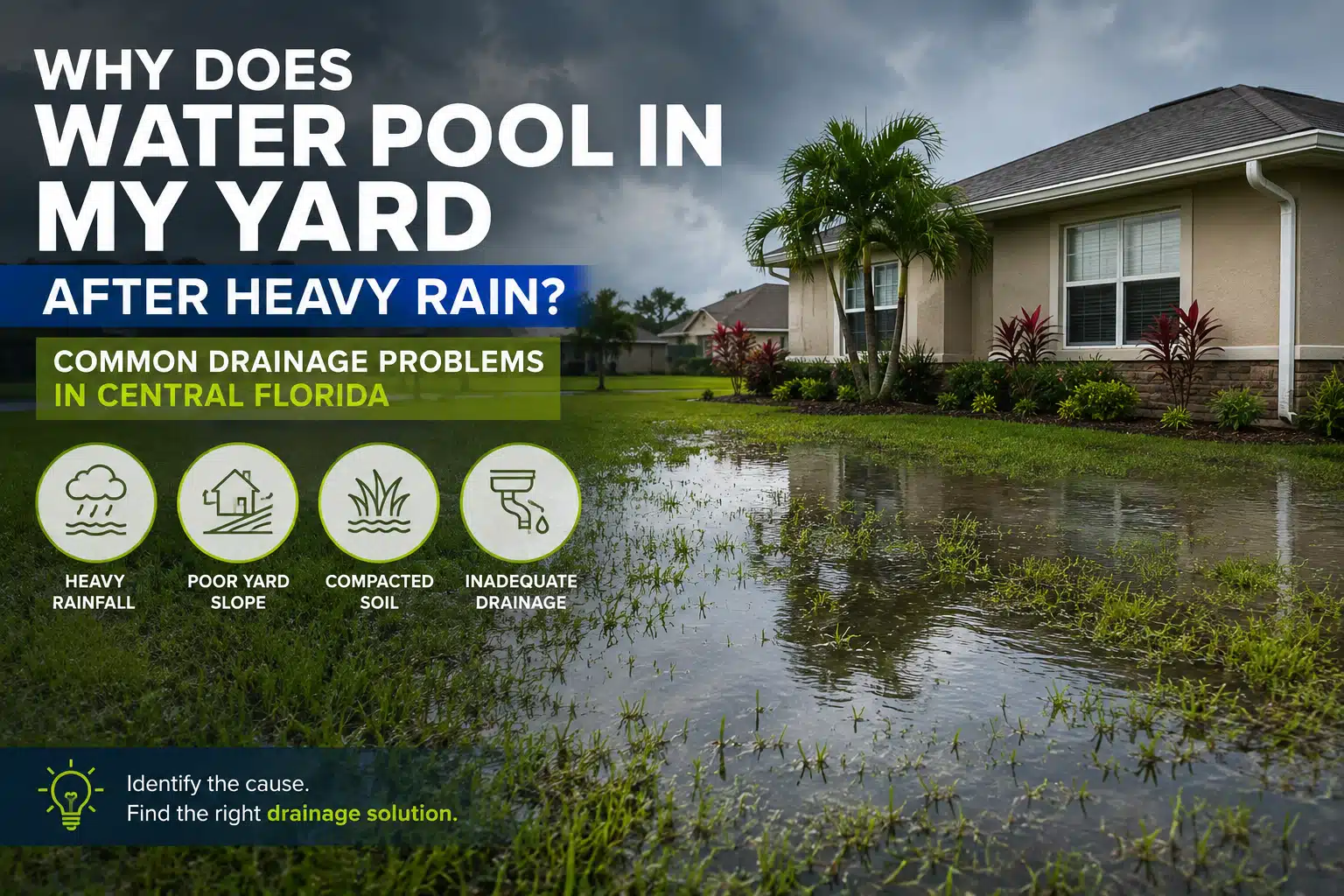
Watering ground that’s already saturated. The opposite problem, and just as fatal. If your yard holds water after a storm — common in parts of Deltona and on the low-lying lots around Port Orange — new sod will rot rather than root. That’s a drainage problem, and it has to be solved before the grass goes down, not after.
How to check what your sprinklers are actually doing
You can’t manage what you haven’t measured, and almost nobody measures this. It takes fifteen minutes:
- Put several straight-sided containers around one zone — tuna tins, small tubs, anything with vertical walls
- Run the zone for fifteen minutes
- Measure the depth in each container and take the average
- Multiply by four — that’s your rate in inches per hour
Two things come out of it. First, your actual application rate. Roughly half to three-quarters of an inch is generally enough to wet about a foot of Florida sand, which reaches most grass roots — beyond that you’re watering past them. Second, and more usefully, the variation between containers tells you whether your coverage is even. If one tin has twice what another does, you have a spacing or pressure problem, and no schedule will fix it.
That’s an irrigation job. It’s also usually a cheap one compared to replacing a lawn.
Quick answers
How long does new sod take to root?
Most St. Augustine roots enough to hold within two to three weeks in warm weather, and is properly established by the end of the 60-day window. Tug a corner gently – if it lifts, it isn’t rooted yet.
Can I water new sod in the middle of the day? During the first 30 days, yes – that’s the point of the exception. After that you’re back to the standard restriction against watering between 10am and 4pm.
Should I water every day forever?
No. Once established, daily watering makes a lawn weaker, not stronger – roots stay shallow because they never need to reach. Deeper and less often beats little and often.
Do the rules apply if I have a well?
In most jurisdictions here, yes. Private wells and pumps are generally covered by the same schedule as utility customers.
What if a water shortage order is in effect?
Shortage phases can override the standard schedule with tighter limits. Check your city’s website or SJRWMD for current status before assuming.
Before you water anything, make sure the ground is right
A watering schedule can only work on ground that’s been prepared to hold water and drain the excess. If your last lawn failed and you’re about to lay another one on the same soil, the schedule isn’t the thing to change.
We install new lawns and sod across Volusia and Seminole County, and every customer gets a written watering schedule on install day plus a follow-up before the establishment window closes.
Find your city: DeBary · DeLand · Deltona · Orange City · Port Orange · New Smyrna Beach · Ormond Beach · Lake Mary · Sanford · Longwood · Winter Springs · Altamonte Springs
Free assessment and quote anywhere we work — 386 848 2531.