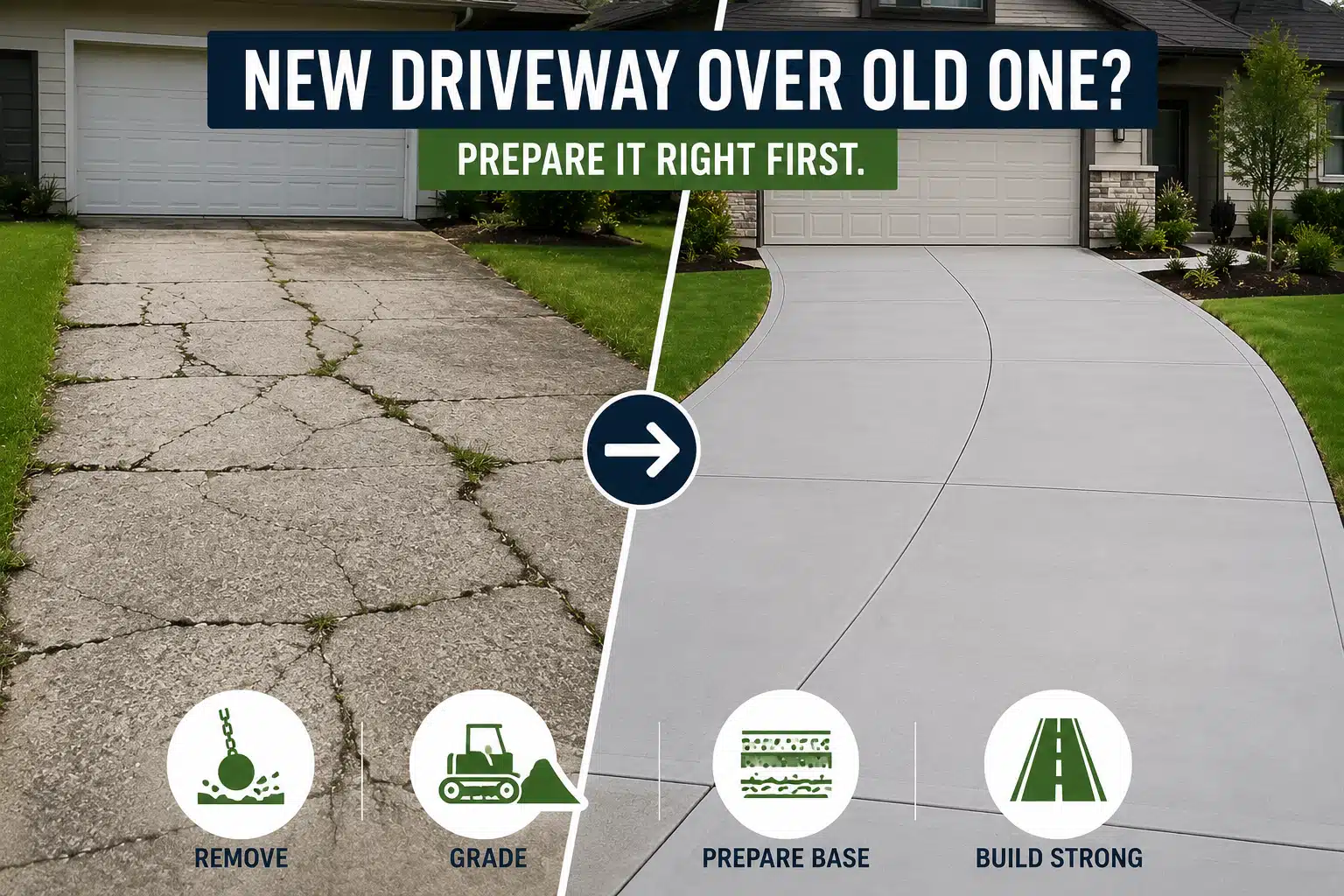



Replacing an old driveway may seem straightforward: remove the damaged surface, install a new material, and you’re done. But what if you could simply put a new driveway over the existing one?
In some situations, a new driveway surface can be installed over an existing surface. However, you should not assume that covering an old driveway will solve the underlying problems. Cracks, soft areas, poor drainage, uneven grading, unstable base material, and significant structural damage can all affect the performance of a new driveway.
Proper driveway replacement preparation is therefore one of the most important parts of the project.
Before deciding whether to build over an existing driveway, the property should be evaluated for surface condition, base stability, drainage, grading, and the type of driveway material being installed.
For property owners in DeBary, DeLand, Lake Mary, Sanford, Port Orange, Longwood, Deltona, Orange City, New Smyrna Beach, Ormond Beach, Winter Springs, and Altamonte Springs, understanding what happens before driveway installation can help prevent premature cracking, rutting, settling, and drainage problems.
Can You Put a New Driveway Over an Old One?
Sometimes, but not always.
Whether a new driveway can be installed over an existing driveway depends largely on the condition of the existing surface and what is underneath it.
If the existing driveway is stable, relatively level, properly drained, and free from major structural failures, an overlay or new surface may sometimes be considered.
However, if the existing driveway has:
- Large cracks
- Major potholes
- Soft or sinking sections
- Significant settlement
- Poor drainage
- Severe erosion
- An unstable base
- Extensive surface failure
simply covering it with a new material may only hide the problem temporarily.
The new driveway can eventually develop the same cracks, depressions, or drainage problems because the underlying issue remains.
That is why old driveway removal and proper base preparation can be necessary before installing a replacement driveway.
What Should Be Checked Before Replacing an Existing Driveway?
Before deciding how to replace a driveway, several factors should be evaluated.
1. Condition of the Existing Surface
Start by examining the current driveway.
Are there small surface cracks, or has the entire driveway deteriorated?
Minor surface wear is very different from structural failure.
Look for:
- Cracks
- Potholes
- Rutting
- Uneven areas
- Crumbling edges
- Sunken sections
- Standing water
The more extensive the damage, the less likely it is that simply covering the old surface will provide a reliable long-term result.
2. Condition of the Base
The surface you see is only part of the driveway.
Underneath it is the base that supports the driveway and distributes vehicle loads.
If the base is unstable, poorly compacted, saturated, or damaged, installing a new surface over it may not correct the problem.
This is why driveway base preparation matters.
A properly prepared base can provide a more stable foundation for the new driveway material.
3. Existing Drainage
Water is one of the biggest factors affecting driveway performance.
If water collects beneath or around an existing driveway, it can contribute to:
- Settlement
- Erosion
- Cracking
- Soft spots
- Base deterioration
- Edge damage
Before installing a new driveway, determine where rainwater is coming from and where it is going.
If the existing driveway has poor drainage, replacing the surface without correcting the water-flow problem may simply lead to another damaged driveway.
When Should an Old Driveway Be Removed?
Old driveway removal may be appropriate when the existing surface or base is too damaged to provide a suitable foundation for the new driveway.
Removal may be considered when you have:
Extensive Cracking
A driveway covered with widespread structural cracks may indicate problems below the surface.
Major Settlement
If sections of the driveway have sunk significantly, installing a new surface over them may not correct the elevation problem.
Unstable Areas
Soft or moving areas can indicate base or soil problems that should be addressed before replacement.
Severe Drainage Issues
If water consistently collects underneath or around the driveway, the drainage problem should be addressed before installing a new surface.
Significant Surface Failure
When the existing material is heavily deteriorated, removal can provide an opportunity to rebuild the driveway properly.
Major Grade Problems
If the existing driveway has an unsuitable slope or elevation, removing it can provide more flexibility for establishing a better grade.
Why Is Driveway Base Preparation So Important?
The driveway surface receives the traffic, but the underlying base provides much of the structural support.
Poor driveway base preparation can contribute to premature failure even when high-quality surface material is used.
A proper preparation process may involve:
- Removing unsuitable material
- Clearing debris and damaged sections
- Evaluating the underlying soil
- Establishing the required grade
- Adding appropriate base material where needed
- Compacting the base
- Addressing drainage
- Preparing the surface for the selected driveway material
The exact process depends on the existing property conditions and the type of driveway being installed.
The key principle is simple:
A new driveway needs a stable foundation, not just a new surface.
How Does Grading Affect Driveway Replacement?
Grading for a driveway determines how water moves across and away from the surface.
A driveway that is too flat may allow water to remain on the surface. A driveway with poorly controlled runoff may direct water toward the lawn, landscaping, or other areas where erosion can occur.
During replacement, the grade may need to be adjusted to improve:
- Surface drainage
- Water runoff
- Driveway transitions
- Connection to surrounding property grades
- Vehicle access
- Overall surface stability
This is especially important if the property already has standing water or erosion issues.
Driveway replacement can therefore be an opportunity to correct problems that were present in the original installation.
What Happens If You Install a New Driveway Over a Damaged One?
Putting a new surface over a failing driveway does not automatically eliminate the original problems.
For example, imagine an existing driveway has a low section caused by settlement.
If a new material is installed over that area without correcting the underlying condition, the new driveway may eventually develop a similar depression.
The same principle applies to drainage.
If water is collecting underneath the existing driveway and the cause isn’t addressed, the new driveway may experience similar problems.
This is why professional evaluation is more valuable than simply asking:
“Can I cover the old driveway?”
The better question is:
“Is the existing driveway stable enough to serve as a foundation for the new one?”
Concrete Driveway vs. Asphalt vs. Gravel Replacement
The preparation process can vary depending on the material selected for the replacement.
Concrete Driveway Replacement
If an existing concrete driveway has extensive cracking, settlement, or structural damage, concrete driveway removal may be necessary before installing a replacement.
Removing the old concrete also provides an opportunity to evaluate the underlying base and grade.
Asphalt Driveway Replacement
Depending on the condition of the existing asphalt, resurfacing or removal may be considered.
If the existing surface has major structural problems, simply adding another layer may not provide the desired result.
Gravel Driveway Replacement
Gravel driveways require proper grading and base preparation because vehicle traffic can create ruts and displacement if the foundation and drainage are inadequate.
In some situations, removing unsuitable material and rebuilding the driveway base may be more effective than repeatedly adding new gravel.
Can Asphalt Millings Be Installed Over an Existing Driveway?
In some driveway projects, asphalt millings can be considered as a practical surface material.
However, the existing driveway and base should still be evaluated first.
If the existing surface is unstable, heavily damaged, or poorly graded, placing millings over it may not address the underlying problem.
Proper preparation can include:
- Removing unsuitable material
- Correcting low areas
- Establishing the appropriate grade
- Preparing the base
- Managing drainage
- Compacting the material
The suitability of asphalt millings depends on the property’s conditions and the intended use of the driveway.
How Drainage Problems Affect Driveway Replacement
Driveway drainage is often overlooked during replacement.
Water can damage a driveway when it repeatedly:
- Collects on the surface
- Runs across the driveway
- Erodes the edges
- Saturates the base
- Flows underneath the driveway
- Collects in low areas
If your existing driveway has drainage problems, replacing the surface without correcting the water-flow pattern may result in recurring damage.
This is where driveway work can overlap with grading, drainage, and fill dirt services.
The objective is not simply to create a new driveway.
It is to create a driveway that works with the surrounding property.
What Is the Proper Driveway Replacement Process?
While every property is different, a typical replacement project may involve several stages.
Step 1: Evaluate the Existing Driveway
Inspect the surface, edges, cracks, settlement, drainage, and overall condition.
Step 2: Determine Whether Removal Is Necessary
If the existing driveway is structurally unsuitable, removal may be the better option.
Step 3: Remove the Existing Material
Depending on the driveway type, this can involve concrete demolition, asphalt removal, or removal of unsuitable aggregate.
Step 4: Prepare the Base
The underlying area is evaluated, graded, and prepared for the new driveway.
Step 5: Correct Drainage and Grading
Water-flow problems and elevation issues should be addressed before the final surface is installed.
Step 6: Install the New Driveway Material
The selected material can then be installed over the prepared foundation.
Step 7: Finish and Compact
Proper finishing and compaction help create a stable and functional driveway surface.
7 Signs You Should Not Simply Cover Your Old Driveway
If you are considering driveway replacement, look for these warning signs:
- Large structural cracks
- Repeated potholes
- Major settlement
- Soft or unstable areas
- Water pooling on or beneath the driveway
- Severe erosion around the edges
- Repeated repairs that have not solved the problem
If several of these conditions are present, complete removal and reconstruction may deserve consideration.
How to Prepare Your Property for Driveway Replacement
Good preparation can make the replacement process more effective.
Before work begins:
Identify Drainage Problems
Note where water collects after rainfall.
Check Existing Grades
Look for low areas and locations where water flows toward the driveway.
Remove Obstacles
Clear unnecessary objects, vegetation, or debris from the work area.
Determine the Desired Driveway Layout
Consider driveway width, access points, transitions, and connection to surrounding areas.
Choose the Appropriate Material
Compare options such as concrete, asphalt, gravel, or asphalt millings based on the property’s needs.
Plan for the Base
Do not focus only on the visible surface. The foundation is a major part of driveway performance.
Common Driveway Replacement Mistakes
Avoiding preparation mistakes can help prevent unnecessary repairs later.
Covering Major Damage
A new surface cannot always correct structural problems underneath it.
Ignoring Drainage
Water problems can continue damaging the replacement driveway.
Skipping Base Preparation
An unstable base can contribute to settlement, rutting, and cracking.
Failing to Correct Grade
Poor grading can leave water sitting on the driveway or direct runoff toward unwanted areas.
Choosing Material Without Considering the Site
The best driveway material depends on the property’s conditions, expected traffic, drainage, budget, and intended use.
Driveway Replacement Services Across Central Florida
Driveway replacement and preparation needs can vary significantly from property to property. Local Sod & Landscape serves residential and property owners throughout Central Florida, including:
- DeBary, FL
- DeLand, FL
- Lake Mary, FL
- Sanford, FL
- Port Orange, FL
- Longwood, FL
- Deltona, FL
- Orange City, FL
- New Smyrna Beach, FL
- Ormond Beach, FL
- Winter Springs, FL
- Altamonte Springs, FL
Depending on the project, related services may include old driveway removal, concrete demolition, asphalt milling, gravel driveway installation, grading, fill dirt, and drainage solutions.
Frequently Asked Questions About Driveway Replacement
Can you put a new driveway directly over an old driveway?
Sometimes, but it depends on the condition and stability of the existing driveway. Major cracking, settlement, drainage problems, or base failure may make removal and reconstruction a better option.
Should I remove my old driveway before installing a new one?
Not always, but old driveway removal may be necessary when the existing surface or underlying base is severely damaged or unstable.
What is driveway base preparation?
Driveway base preparation involves creating a stable foundation beneath the driveway surface. It can include removing unsuitable material, grading, adding appropriate base material, and compacting it.
Why is grading important for a driveway?
Proper grading helps control how water moves across and away from the driveway. Poor grading can contribute to standing water, erosion, and long-term surface damage.
Can I put gravel over an old concrete driveway?
It depends on the condition and grade of the existing driveway. The surface should be evaluated for stability, drainage, elevation, and suitability before adding another material.
Can asphalt millings be installed over an existing driveway?
In some situations, yes. However, the existing surface and base should be stable and properly graded. Severe damage or drainage problems may require additional preparation or removal.
What causes a new driveway to crack or settle?
Common contributing factors include an unstable base, poor compaction, drainage problems, unsuitable soil conditions, improper grading, and heavy or repeated loading.
Should drainage be fixed before driveway replacement?
If the existing driveway has a drainage problem, addressing the water-flow issue before installing the new surface can help reduce the risk of recurring damage.
Ready to Replace Your Old Driveway?
A new driveway should be more than a new layer placed over an old problem.
Before replacing an existing driveway, evaluate the surface condition, base stability, drainage, grading, and surrounding property. In some cases, the existing driveway may be suitable for an overlay or new surface. In others, old driveway removal and complete base preparation may provide a better foundation for the replacement.
Local Sod & Landscape provides related property services including concrete demolition, asphalt milling, gravel driveway installation, grading, fill dirt, and drainage solutions throughout Central Florida.
Whether your property is in DeBary, DeLand, Lake Mary, Sanford, Port Orange, Longwood, Deltona, Orange City, New Smyrna Beach, Ormond Beach, Winter Springs, or Altamonte Springs, proper planning can help you avoid simply covering an existing problem.
Before you build over your old driveway, make sure the foundation is worth building on.