

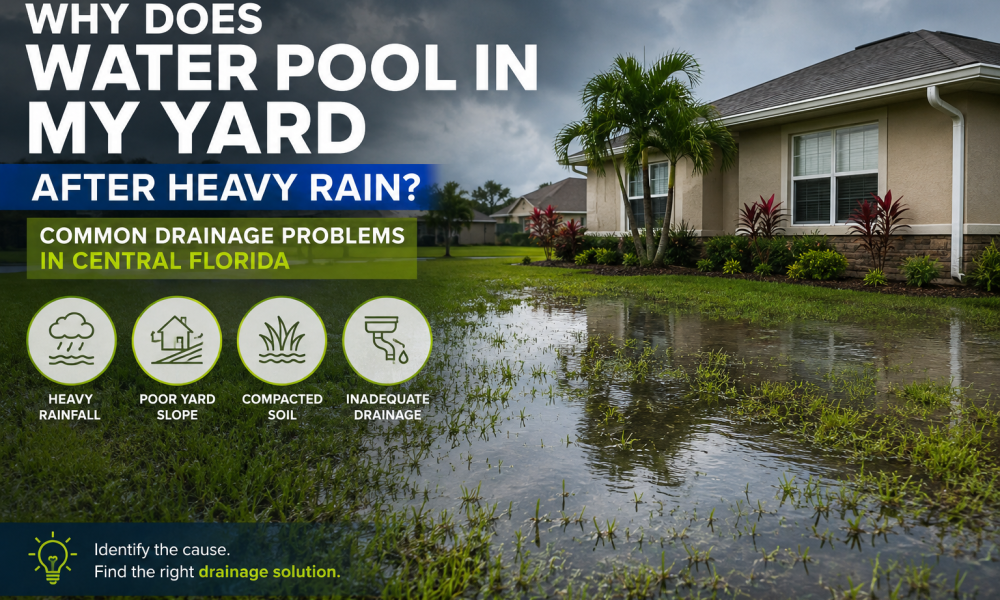
Heavy rain is normal in Central Florida, but water pooling in your yard after heavy rain shouldn’t always be. If the same areas repeatedly become saturated, muddy, or flooded after storms, your property may have underlying yard drainage problems.
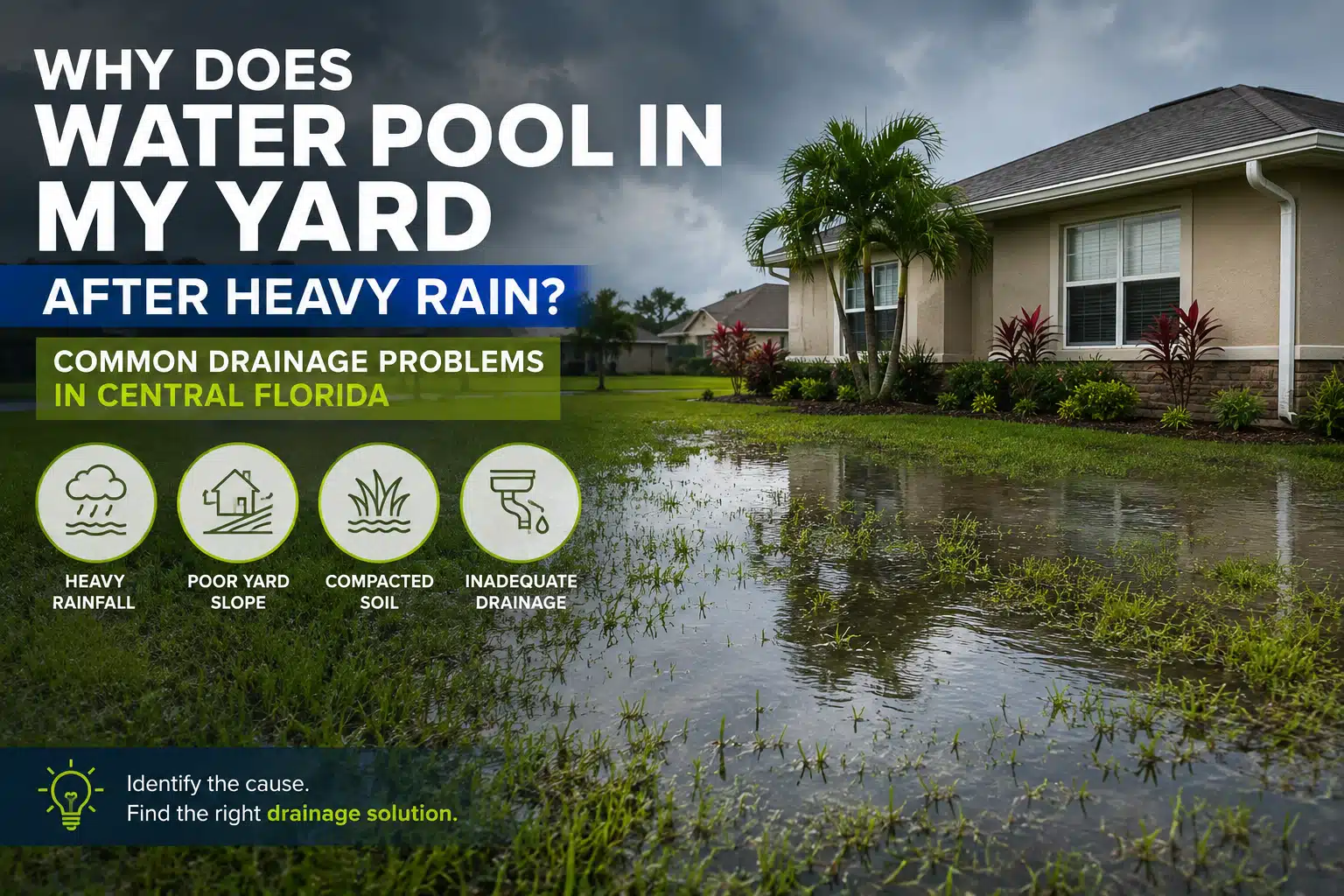
Standing water can result from several conditions, including poor yard grading, low spots, compacted soil, excessive runoff, inadequate drainage, erosion, or irrigation issues. The visible puddle is often only a symptom. The real problem is figuring out why water is collecting there and where it should go instead.
For homeowners and property owners in DeBary, DeLand, Lake Mary, Sanford, Port Orange, Longwood, Deltona, Orange City, New Smyrna Beach, Ormond Beach, Winter Springs, and Altamonte Springs, understanding the cause of poor yard drainage can help you choose a practical solution.
Depending on the property, the answer may involve drainage installation, yard grading, fill dirt, irrigation adjustments, or a combination of services.
Why Does Water Pool in My Yard After Heavy Rain?
Water usually pools when rainfall reaches an area faster than the property can naturally move or absorb it.
Common causes of standing water in a yard include:
- Low spots or depressions
- Poor yard grading
- Compacted soil
- Slow surface drainage
- Excessive runoff from higher areas
- Improperly directed downspout water
- Soil erosion
- Inadequate drainage systems
- Irrigation problems
- Changes to the property’s original grade
A small amount of temporary water accumulation during an unusually heavy storm may not indicate a serious issue. However, if water repeatedly collects in the same location or remains for an extended period, it is worth investigating.
The important question is not simply, “How can I remove this water?”
It is:
“Why is the water collecting here, and where should it go?”
Answering that question helps determine which drainage solution is appropriate.
7 Signs You May Have Yard Drainage Problems
Standing water is one of the easiest signs to notice, but several other symptoms can indicate poor yard drainage.
1. Water Keeps Collecting in the Same Location
If the same portion of your lawn turns into a puddle after every major storm, there may be a low spot, grading issue, or inadequate drainage path.
Repeated water accumulation is more important than a single isolated puddle because it indicates a recurring water-flow pattern.
2. Your Lawn Stays Soggy After Rain
A healthy lawn should not remain saturated indefinitely after rainfall.
Signs of excessive moisture can include:
- Soft or muddy soil
- Yellowing grass
- Thin or struggling turf
- Persistent wet areas
- Poor root development
- Difficulty mowing the lawn
If you are planning new sod installation, drainage should also be considered before installing new turf. A new lawn cannot correct an underlying property drainage problem by itself.
3. Soil Is Washing Away
Not every drainage problem creates standing water. Sometimes water moves too quickly.
Heavy runoff can create:
- Small erosion channels
- Exposed roots
- Washed-out soil
- Mud deposits
- Eroded lawn edges
- Soil buildup in low areas
When erosion changes the shape or grade of the property, it can eventually create additional drainage problems.
4. Water Flows Toward Your Home
Water moving toward a house instead of away from it is an important warning sign.
Poor grading or uncontrolled runoff can cause water to collect near structures, particularly during heavy rainfall.
The solution is not necessarily to add more soil around the area. The overall water-flow pattern should be evaluated first.
5. Low Spots Keep Returning
Have you filled the same depression several times, only to see it come back?
Repeatedly adding a small amount of soil may not address the underlying problem.
A recurring low spot may require fill dirt and grading to restore the elevation and create a more functional surface slope.
6. Some Lawn Areas Are Wet While Others Are Dry
Uneven moisture does not always mean you have a drainage problem.
It could also be caused by an irrigation issue.
For example, a damaged sprinkler head or poorly adjusted irrigation zone can oversaturate one portion of the lawn while another area receives insufficient water.
Understanding whether the water comes from rainfall, runoff, or irrigation is an important part of identifying the problem.
7. Driveways and Landscape Areas Are Showing Erosion
Runoff can affect more than grass.
If water consistently crosses your:
- Driveway
- Landscape beds
- Walkways
- Lawn edges
- Sloped areas
- Property boundaries
It may be necessary to redirect or control the flow.
What Causes Poor Yard Drainage in Central Florida?
Central Florida properties can have different drainage conditions depending on grading, soil, elevation, surrounding properties, landscaping, and existing drainage systems.
Even a yard that appears flat can have small elevation changes that determine where water naturally travels.
Low Areas
Low spots naturally collect water because rainfall and runoff move toward lower elevations.
If there is no effective path for that water to leave, standing water can remain after the storm.
Poor Yard Grading
Grading determines the direction water travels across the property.
When a yard has an improper slope, rainfall may move toward low areas, landscaping, driveways, or structures instead of moving toward an appropriate drainage path.
Compacted Soil
Compacted soil can limit how quickly water moves through the ground.
This can become especially noticeable in areas with heavy foot traffic, equipment use, construction activity, or repeated landscaping work.
Excessive Runoff
Your yard may receive water from several sources, including:
- Higher sections of your property
- Roof runoff
- Downspouts
- Driveways
- Hard surfaces
- Adjacent areas
The amount and direction of incoming water should be considered before choosing a drainage system.
Is It a Drainage Problem or a Grading Problem?
Drainage and grading work together, but they are not the same thing.
Grading changes the elevation and slope of the ground to influence how surface water moves.
Drainage collects, redirects, or carries water away from areas where it causes problems.
For example, a low section of a yard may benefit from fill dirt and grading. Another property may have sufficient grading but still require a French drain or catch basin to manage concentrated water.
Potential solutions can include:
- Yard grading
- Fill dirt
- French drains
- Catch basins
- Surface drainage
- Downspout extensions
- Irrigation adjustments
- Customized drainage systems
The right approach depends on the property’s actual water-flow conditions.
When Does a Yard Need Fill Dirt or Grading?
Fill dirt for a yard can be useful when low areas, uneven elevations, or settling contribute to drainage problems.
Common signs that grading or fill dirt may be needed include:
- Persistent depressions
- Repeated standing water
- Uneven lawn surfaces
- Soil erosion
- Settled sections
- Poor surface water flow
- Difficulty establishing grass
However, simply dumping dirt into a puddle does not automatically solve poor drainage.
The material needs to be placed and graded correctly so the finished surface supports the intended water-flow pattern.
This is particularly important when preparing a property for new landscaping or sod installation.
French Drain vs. Catch Basin: Which One Does Your Yard Need?
Homeowners often search for French drain vs. catch basin when looking for a solution to standing water. Both can help manage water, but they serve different purposes.
French Drain
A French drain generally collects and redirects water through a subsurface drainage path.
It can be useful when water needs to be collected below or near the surface and moved away from a problem area.
Catch Basin
A catch basin collects water at a specific surface location.
It can be useful where runoff naturally concentrates at a low point.
Surface Drainage
Surface drainage manages water at or near ground level and directs it toward an appropriate outlet.
The important takeaway is that not every yard needs the same drainage system.
A professional assessment can help determine whether grading, a French drain, a catch basin, surface drainage, or another approach is appropriate.
Can Irrigation Cause Water to Pool in Your Yard?
Yes. Rainfall is not the only source of excess water.
An irrigation system can contribute to poor yard drainage when a sprinkler head is damaged, incorrectly positioned, or providing too much water to a particular area.
Potential signs include:
- Water pooling when it has not rained
- One section remaining wetter than the rest
- Sprinkler overspray
- Broken sprinkler heads
- Uneven irrigation coverage
- Water spraying onto driveways or walkways
If wet areas appear even during dry weather, irrigation should be considered as part of the diagnosis.
This is why drainage and irrigation sometimes need to be evaluated together.
Why Should You Fix Standing Water Instead of Ignoring It?
A recurring puddle can eventually become more than an inconvenience.
Lawn Damage
Grass may struggle when the root zone remains excessively wet.
Soil Erosion
Fast-moving runoff can remove valuable soil and reshape the property.
Difficult Maintenance
Muddy or soft areas can make mowing and routine lawn maintenance difficult.
Recurring Landscaping Problems
If drainage problems remain unresolved, new sod or landscaping may struggle even after installation.
Changing Property Conditions
Repeated erosion, settling, and runoff can gradually change the way water moves across the property.
Addressing the underlying problem can be more effective than repeatedly treating the visible symptom.
How Is a Yard Drainage Problem Diagnosed?
A professional drainage assessment should begin with the property rather than a predetermined product.
Step 1: Identify the Water Source
Determine whether the water comes from:
- Rainfall
- Irrigation
- Roof runoff
- Higher ground
- Adjacent areas
- Driveways or other hard surfaces
Step 2: Follow the Water
Observe where the water travels during and after rainfall.
Does it collect in one low area? Flow toward the house? Cross the driveway? Wash away soil?
Step 3: Evaluate the Grade
The property’s elevation and slope can reveal whether grading is contributing to the problem.
Step 4: Examine Existing Drainage
Existing drains, downspouts, surface channels, and other components should be considered before installing additional drainage.
Step 5: Choose the Appropriate Solution
Depending on the findings, the property may require:
Grading and fill dirt, drainage installation, irrigation correction, or a combination of services.
How to Prevent Future Yard Drainage Problems
You cannot control Central Florida’s rainfall, but you can monitor conditions that contribute to poor drainage.
Maintain Proper Grading
Watch for new depressions and areas where water begins collecting.
Monitor Downspouts
Make sure roof runoff is not concentrated in one part of the lawn.
Maintain Drainage Paths
Leaves, soil, grass, and debris can interfere with surface water movement.
Check Irrigation
Look for broken sprinkler heads, excessive watering, and uneven coverage.
Address Low Areas
Recurring low spots should be evaluated rather than continually covered with small amounts of soil.
Consider Drainage Before New Sod
If a property has persistent standing water, address the underlying drainage condition before installing new turf.
Yard Drainage Services Across Central Florida
Yard drainage problems can occur throughout Central Florida, and every property may have different site conditions.
Local Sod & Landscape serves property owners in:
- DeBary, FL
- DeLand, FL
- Lake Mary, FL
- Sanford, FL
- Port Orange, FL
- Longwood, FL
- Deltona, FL
- Orange City, FL
- New Smyrna Beach, FL
- Ormond Beach, FL
- Winter Springs, FL
- Altamonte Springs, FL
Whether the problem involves standing water, poor grading, low areas, runoff, erosion, or irrigation, the appropriate solution should be based on the property’s specific conditions.
Frequently Asked Questions About Yard Drainage Problems
Why does water pool in my yard after heavy rain?
Water can pool because of low spots, poor grading, compacted soil, excessive runoff, insufficient drainage, or changes to the property’s surface grade. Repeated pooling in the same location is a strong reason to investigate the underlying cause.
How do I fix standing water in my yard?
The solution depends on the cause. Possible approaches include grading, fill dirt, French drains, catch basins, surface drainage, downspout management, or irrigation adjustments.
Does every yard with standing water need a French drain?
No. A French drain is only one possible drainage solution. Some properties may need grading, fill dirt, a catch basin, surface drainage, or irrigation correction instead.
Can fill dirt solve poor yard drainage?
Fill dirt can help raise low areas and support proper grading, but simply adding soil does not solve every drainage problem. The finished elevation and water-flow direction must also be considered.
Why does my lawn stay wet after the rain stops?
Persistent wetness can result from poor drainage, low spots, compacted soil, grading problems, or excessive irrigation. Identifying the source of the water is an important first step.
Can poor grading cause standing water?
Yes. When a yard does not have an appropriate surface slope, rainfall can collect in low areas rather than moving toward a suitable drainage path.
Should drainage be addressed before installing new sod?
In many cases, yes. If standing water or poor grading remains unresolved, new sod may experience similar problems. Proper soil preparation, grading, drainage, and irrigation can all contribute to healthier turf establishment.
How do I know if my problem is drainage or irrigation?
Observe when the water appears. If pooling occurs mainly after rainfall, drainage or grading may be contributing. If a wet area appears even without rain, irrigation could be part of the problem. Some properties can have both issues.
Need Help With a Yard That Holds Water?
If your property repeatedly develops standing water, soggy lawn areas, erosion, or low spots after heavy rain, replacing grass or repeatedly adding soil may not address the real problem.
The first step is understanding where the water comes from, where it is going, and why it is collecting there.
Depending on the property, the solution may involve professional drainage, grading, fill dirt, irrigation adjustments, or related lawn preparation services.
Local Sod & Landscape serves DeBary, DeLand, Lake Mary, Sanford, Port Orange, Longwood, Deltona, Orange City, New Smyrna Beach, Ormond Beach, Winter Springs, and Altamonte Springs.
If standing water keeps returning after every major storm, don’t just treat the puddle.
Find out why the water is there and choose a drainage solution based on the actual problem.